Mellett Golf Course Design
Routing Plans
The land is walked and evaluated before a line is drawn, so the eighteen holes follow the natural topography instead of fighting it.
Chapter 01
Where routings go wrong
A golf hole can be built almost anywhere with enough earthmoving. That is exactly the problem. When features are imposed onto a piece of ground rather than found on it, the result fights its own drainage, needs mass grading to make it work, and rarely plays like it belongs on the property it sits on.
Mellett Golf Course Design starts from the opposite instinct: bring the natural topography and vegetation into the design of the golf holes, rather than imposing golf course features into the natural topography that was already there.
That instinct is the same one architects call the old-fashioned way, taken from the way golf course architecture was practiced over a hundred years ago, before mass grading equipment made it easy to move a hillside instead of routing around it.
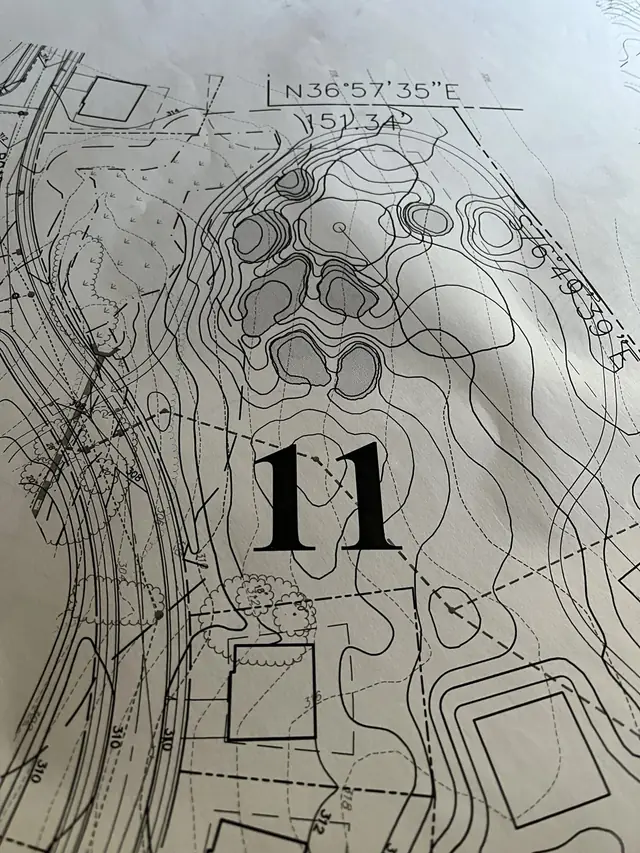
Contour grading plan for hole 11, spot elevations and shaded bunkers
How the routing is found
The land is intensely evaluated during the routing plan phase, on foot, before a single hole is drawn. That means reading the topography and the vegetation the way it already sits, not the way a plan might prefer it to sit, and noting where the ground itself suggests a fairway, a green site or a hazard.
Nature is the greatest golf course architect, and the job during a routing plan is to locate the golf holes that are already on the site rather than invent them from a blank sheet. On a property near Salisbury, North Carolina, or anywhere else the firm works, that walk is the actual first step of every project, ahead of any drawing.
The routing plan is also where scale gets decided: how far apart the greens and tees actually sit once real distance and real elevation change are accounted for, not how they look on a survey drawing. A hole that reads short on paper can play long once the walk shows the rise between tee and green, and that difference belongs in the routing before it becomes a problem in construction.
Chapter 03
Sustainable Golf Course Design starts at the routing
Minimal site grading and natural vegetation kept in play are not a separate service tacked onto the drawings afterward. They are what a good routing plan already produces, which is why Sustainable Golf Course Design sits on the same services list as Routing Plans rather than off on its own.
Every later drawing for a project, from the master plan to the grading and stormwater plans to the construction documents, is built on the lines the routing plan already set down. Call John Mellett at 704.877.5600 to talk through the routing for a specific piece of ground before any of those later plans get drawn.
Mellett Golf Course Design is based at 1545 West Ridge Road in Salisbury, North Carolina. Call 704.877.5600 to start with a walk of the property.
More from the same drawing set
The other five services
Master Plans
Grading & Stormwater Management Plans, SCMs, BMPs · Seeding, Sodding, & Planting Plans
Construction Documents · Construction Inspection · Shaping and Construction Services (by Project)
Peer Reviews of ASGCA and Celebrity Golf Course Designers Plans · Expert Witness Testimony & Zoning Board Hearings · Municipal, Public, Club Presentations
Clubhouse and Facility Site Design · Irrigation Design (by business partner) · Arborist/Tree Services (by business partner) · Hydrogeological Services (by business partner) · Golf Course Surveys (by business partner)