Land, Water & Planting
Grading, Stormwater and Planting Plans
Contour grading, stormwater control measures and seeding, sodding and planting plans, drawn to keep site grading to a minimum.
Chapter 01
Reading the land before the grader moves
A golf hole is graded to whatever the routing already asked for, not the other way around. John Mellett draws contour plans for grading and stormwater management, SCMs, BMPs, before a piece of equipment touches the site, and the goal on every sheet is the same one that shaped the routing: minimal site grading. The land keeps its shape and its drainage keeps working, because the plan was built to match what is already there instead of overriding it.
The contour plans for hole 3 and hole 11 at this studio show the discipline in practice: spot elevations, shaded bunkers, and a green complex worked into the existing fall of the ground rather than raised or flattened to fit a template. Every grading sheet leaving the Salisbury, North Carolina studio carries that same standard, whether the project is a single green renovation or a full eighteen-hole routing.
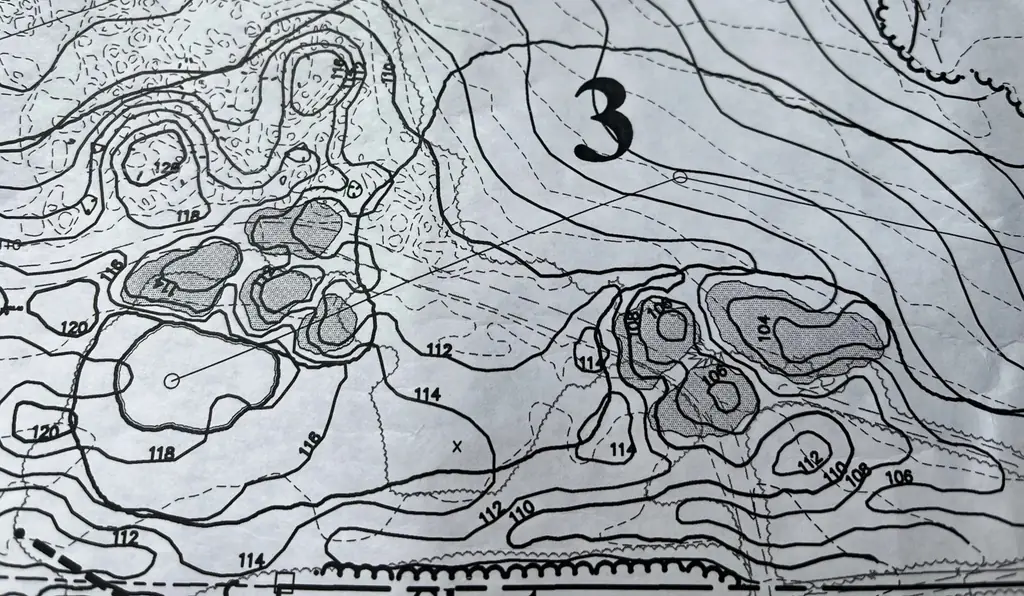
Wide contour grading plan for a golf hole, showing shaped bunkers and elevation lines.
Stormwater control measures and best management practices, planned with the grading
Grading & Stormwater Management Plans, SCMs, BMPs is one line on the services list, and it is written that way on purpose: the stormwater work is not a separate drawing layered on after the holes are shaped. SCMs, stormwater control measures, are the physical features, a swale, a basin, a buffer strip, that hold and slow water on the property. BMPs, best management practices, are the working habits around them: how soil is protected during construction, where equipment can and cannot run, how a disturbed area gets stabilized before the next storm.
Handled together with the contour plan, the water on a golf course becomes part of the design instead of a problem chasing it. A fairway that sheds water into a planned swale instead of pooling on the surface plays better in July and needs less maintenance in November. That is the outcome the grading and stormwater sheets are drawn to produce, plan by plan, out of the Salisbury office at 704.877.5600.
Chapter 03
Seeding, sodding and planting plans
Seeding, Sodding, & Planting Plans is the last named service in this group, and it answers a practical question for the contractor: which surfaces get seeded, which get sodded, and which areas of existing native vegetation are left alone. Sod goes down where a surface needs to be playable fast, greens surrounds, tee tops, high traffic collars. Seed does the work everywhere the timeline allows it, which is most of a golf course, because a seeded surface roots into the ground it will actually live on.
Native vegetation that already suits the site, dune grasses on a coastal tract, hardwood edges on a Piedmont property, is planned to stay rather than be stripped and replaced. Where a project also calls for an irrigation system, the planting plan is coordinated with the firm's business partner handling that design, so heads, zones and plant material line up on the same sheet instead of fighting each other after installation.
Mellett Golf Course Design, Salisbury, North Carolina. Call John Mellett at 704.877.5600.